Showing posts with label faculty profile. Show all posts

Thursday, February 7, 2013

Faculty Profiles 2012: TV and Film Industry Honors Professor Dennis W. Mazzocco


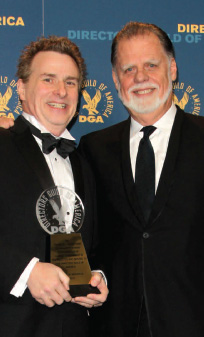
Dennis Mazzocco (left) received the prestigious Franklin J. Schaffner Award from Taylor Hackford. (photo: Frederick M. Brown/Getty Images North America)
By Neena Samuel

At the 2 p.m. walkthrough in the Grand Ballroom at Hollywood & Hyland in Los Angeles this past January, Dr. Dennis W. Mazzocco, associate professor of radio, television, film, walked up to the podium, practiced his speech on the teleprompter and then went down to check the seating arrangements at the tables directly in front of the stage. “I went around and made sure I knew where Martin Scorsese was sitting, where George Clooney and Jennifer Aniston were, where Helen Mirren was going to be,” he says. “I knew very famous people were going to be there, and I wanted to be able to visualize it so I wouldn’t be startled later.” That evening, Mazzocco would be honored at the 64th Annual Directors Guild of America (DGA) awards ceremony, where he would receive the Franklin J. Schaffner Award for outstanding career achievement and extraordinary service.

“Winning that honor has been the highlight of my career,” says Mazzocco, an Emmy Award-winning director, producer, and writer. The award was presented to him before an audience of 1,600 by DGA president and Academy Award-winning director Taylor Hackford, who praised him as a longtime Guild leader who stood up for members’ creative and economic rights. Knowing ahead of time which A-listers would be in his line of sight helped calm Mazzocco’s nerves during his acceptance speech, where he shared that his interest in broadcasting began when he saw The Beatles perform on The Ed Sullivan Show in 1964.

He was only about 9 years old at the time, but watching that performance, he recalls, “was the first time I became aware of the connection between the picture and the sound, and was able to connect the visuals with the cuts in the music. But I never thought I could be in media or television; I thought it was beyond me.”

Later, as a pre-med student at Seton Hall University, Mazzocco re-ignited his passion when he got involved with the student-run college radio station. “It’s one of those experiences of someone going to college and discovering a whole new side of himself that he never knew existed; I realized I could have a media career after all,” he says. He graduated with a double major in psychology and communication arts, and would later go on to pursue doctoral studies at the University of California at San Diego.

His first job was with ABC, where, among the many hats he wore, he was an associate director in the sports division during the 1980s. As the industry’s technology evolved and Mazzocco’s skills grew, he wanted to challenge himself creatively and was able to compete for jobs that required him to not only direct, but also produce and write. Over the years he’s worked on many notable news, entertainment and sports programs, including The Academy Awards, Good Morning America, Nightline, Dancing with the Stars, The Super Bowl, The World Series and 12 Olympic broadcasts. He has won nine Emmy Awards (among 20 career nominations) and three Cine-Gold Awards for documentary excellence, and has also worked on the Peabody Award-winning and DGA Award-nominated ABC 2000, a 23-hour ABC News special seen by 175 million viewers. At the DGA, he served as a council chair for six years before being elected an associate member of the National Board in 2009 – the third tenured professor and the only one with a Ph.D. on the board in the Guild’s 75-year history.

Mazzocco came to Hofstra in 1999, where he now teaches in the School of Communication’s M.F.A. in Documentary Studies program, as well as undergraduate classes in television writing, production, media aesthetics and history. “When I was looking for my place in academe, I knew I had to find an institution that respected the scholarly side of me, but also was flexible enough and open to accommodate my artistic and professional sides as well,” he says. “I looked all over the country and felt Hofstra was one of those unique places where I would fit in.” Hofstra’s location also afforded him the convenience of being close to his family in New Jersey as well as media contacts in New York City.

Over the years, his teaching philosophy has centered on preparing students not only with technical skills, but with the problem-solving skills that are so crucial for survival in the industry. “A lot of students believe that if they just learn the software or hardware, they are going to be a better candidate for a job after graduation,” he says. “But what I generally tell them is that it might land you an entry-level position, but won’t prepare you for a career in leadership in the industry. After a while, most students aspire for a deeper experience.” What’s most in demand, according to Mazzocco, is the ability to think critically about how to approach problems in the workplace. “Today’s graduates not only have to be flexible and collaborative, but they also need to be able to speak well and argue logically, as well as work on a superior level.”

Students have taken his lessons to heart – Mazzocco was named the School of Communication’s Distinguished Teacher of the Year in 2006. “Hofstra students choosing me, when we have so many great faculty, was really a thrill and I cherish it as much as I do my Emmy Awards, my Schaffner Award or any other professional award because to be a professor that students appreciate and acknowledge is a real honor and makes it all worthwhile,” he notes.

“Dennis combines in-depth industry experience with serious scholarly engagement – a wonderful combination for his students and colleagues,” says School of Communication Dean Evan W. Cornog, who was in the audience when Mazzocco received his DGA award. Hofstra President Stuart Rabinowitz also notes that Mazzocco is among the many accomplished artists and communication professionals (including alumni Francis Ford Coppola, Scott Ross, Avi Arad, Phil Rosenthal and Chris Albrecht) who have attended or taught at Hofstra.

Over the last four years, when he isn’t teaching, Mazzocco has worked at ABC News as a stage manager and associate director on shows such as Nightline and Weekend Good Morning America. This spring, he also began handling control room operations for This Week with George Stephanopoulos.

He should probably clear some room on his shelf for a few more Emmys.

Faculty Profiles 2012: Research Leads to Help for Human Trafficking Survivors

Work by Dr. Gregory Maney and His Grad Students Uncovers a Victimized Population


Those who think human trafficking is a crisis only in third world countries may be shocked by the findings of research conducted by Hofstra Sociology Professor and Department Chair Gregory Maney, six of his graduate students, and an advocacy group called LifeWay Network. The unfortunate truth is that extensive trafficking is taking place in the New York City metropolitan area, including on Long Island.


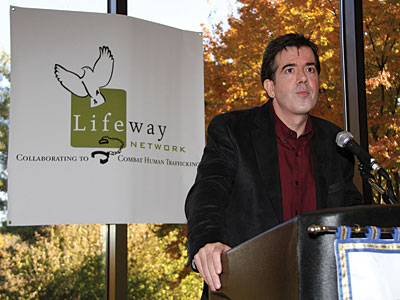
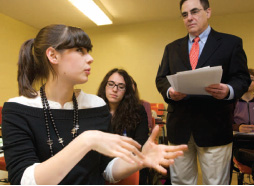
Dr. Greg Maney at the press conference to release the findings of research on human trafficking in the New York metropolitan area.
LifeWay Network approached Dr. Maney for help in answering some important questions. The religious-based, nonprofit coalition wanted to know more about the extent of trafficking in the New York metropolitan area, the service needs of trafficking survivors, and the availability of these services. Sister Joan Dawber, executive director of LifeWay Network, said, “In particular, we wanted to be really sure there was a need for safe housing.” LifeWay board member David Pryor said some in the organization were familiar with Dr. Maney’s interest in social justice issues and in collaborative research that has the potential to positively impact people’s lives.

After hearing from LifeWay Network, Dr. Maney approached some of his Hofstra students about the proposed research project. “I was teaching graduate courses as part of the Master’s Program in Applied Social Research and Public Policy. I asked the students whether they would be interested in this kind of research, and you should have seen their reactions. They were just thrilled to think that they could be working with a coalition that’s dealing with one of the most pressing human rights issues of our time.”

Between May and December of 2010, LifeWay Network staff and board members, Dr. Maney, and the graduate students worked together to design, administer, and analyze surveys and interviews of area private service providers, funding and coordinating agencies, and law enforcement representatives. On November 9, 2011, Hofstra hosted a press conference to release the findings.

Regarding the scope of trafficking, the report estimates that private service providers in the New York City metropolitan area interacted with more than 11,000 trafficking survivors since 2000, and more than 1,600 in 2011 alone.
Dr. Maney commented on the findings, “these figures far exceed official estimates, yet only scratch the surface of the actual number of trafficking victims. Our study does not account for trafficking survivors who managed to escape and immediately left the area, survivors who remain in the area who have yet to interact with private service providers, victims who continue to be held captive, and those who have died while being trafficked. The findings underscore not only the pervasiveness of the problem, but the scope of this tragedy. Every person trafficked has experienced extreme suffering, hardship and injustice.”

New York state, federal, and international laws mandate a wide range of services for trafficking survivors. The report, however, indicates that basic needs of survivors are often not being met. Regarding housing: 86.6 percent of survivors who made contact with private service providers were in need of safe, long-term housing, but only 3.9 percent of clients actually received it. While emergency shelters were more readily available, they were not suitable for survivors because of safety issues, lack of training of the staff, limited services, and limited duration of availability.

High rates of demand for other critical services were also largely unmet, including medical care, telephone services, formal/ general education, and volunteer programs for survivors. Dr. Maney said, “A failure to meet the service needs of survivors increases the likelihood of being re-trafficked, physical and psychological complications, social isolation, substance abuse, poverty, and suicide.”

The report offers other surprising findings. While media coverage often focuses upon sex trafficking, the research indicates that there is also a large amount of other types of labor trafficking in the New York metropolitan area. Private service providers responding to the survey indicated that 21.5 percent of the survivors with whom they have interacted were victims of labor trafficking. An additional 7 percent were victims of a combination of sex and labor trafficking.


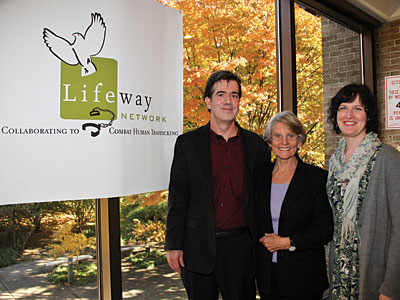
(L to r) Dr. Maney; Sister Joan Dawber, executive director of LifeWay Network; and Faith Huckel, executive director of Restore NYC.
There is also a widespread assumption that only women are victims of trafficking. Yet survey respondents indicated that 13.4 percent of the survivors to whom they provided services were men. And in contrast to the emphasis, until recently, upon providing services to foreign-born victims, respondents reported that nearly two-thirds (65.6 percent) of survivors were born in the United States.

Not surprisingly, those that don’t fit the stereotypical image of trafficking victims were less likely to receive services. Survey respondents indicated that the following subgroups of survivors were frequently underserved: male survivors, transgender survivors, domestic born survivors, survivors under the age of 18, and female labor trafficking survivors.

Identifying the victims of human trafficking presents several challenges. Some trafficking victims fear coming forward, while others do not even recognize that they have been trafficked. The authors of the report recommend expanded training on identifying and assisting victims for service providers and law enforcement agencies alike. They also call upon the media to extensively publicize the National Human Trafficking Resource Center hotline and to provide the public with information regarding the indicators of human trafficking (i.e., asking possible victims if they are free to leave their place of work; if they receive all their earnings directly; and if they are able to contact friends and family members).

With the help of the report, LifeWay has established a new housing program for trafficking survivors. The program is only the second of its kind in the area. For Dr. Maney, the outcome demonstrates how research partnerships with community-based organizations can play critical roles in not only raising awareness of serious human rights abuses, but also assisting in the protection and promotion of human rights.

“The participating graduate students and I experienced firsthand the rich insights and transformative potential of research done in partnership with a community-based organization,” said Dr. Maney. Graduate student Nicole Wiktor said of the experience: “The most valuable lesson was that we were able to narrate a story with data that tells the truth and that attempts to make a difference. I think this project is something we can be very proud of. The fact that a housing program was established as a result of it is amazing. This is certainly a cause that has grown close to my heart through our research and the great people that were part of the project.”
A copy of the report is available online at lifewaynetwork.org (click on the Resources tab).

Wednesday, February 6, 2013

Faculty Profiles 2012: Reading Between the Lines

Dr. Rob Leonard’s Forensic Linguistics Program Is Attracting Students to a Fast-Growing and Intriguing Legal Field

Imagine a murder suspect facing the possibility of life imprisonment because of a contracted verb form. This is what happened in the case of Brian Hummert, who was accused of strangling his wife to death in York County, Pennsylvania, in 2004. He tried to exonerate himself by pointing to anonymous letters his wife had received before her death, one purportedly from a stalker and the other from a jilted lover who claimed responsibility for the murder.

As an expert witness in that case, Robert Leonard, Ph.D., rock star turned Fulbright Scholar turned linguistics professor at Hofstra University, testified that he noticed rare and striking similarities between Hummert’s writing samples and the two supposedly anonymous letters. Hummert would contract negative phrases (for example, “I do not” would always be “I don’t”), but he never contracted positive ones (“I am” would always remain “I am” and never “I’m”), a pattern that Leonard found was repeated in the other letters. It was a valuable clue in the case against Hummert, who was convicted of first-degree murder in 2006. Jury members reported that Rob Leonard’s testimony helped form their opinion that the man had faked the letters and killed his wife, and that the murder was premeditated.

The emerging field of study that helps unearth such clues and patterns is forensic linguistics, the scientific study of language as it applies to issues of law. Rob Leonard is one of the world’s experts, having worked on a number of high-profile cases in addition to the Hummert case, including the JonBenet Ramsey murder, arson threat letters against married actors Taye Diggs and Idina Menzel, and the doctored tape case involving the Canadian prime minister. He has consulted with the FBI and trained its agents in the use of forensic linguistics in threat assessment and counterterrorism. He is also director of Hofstra’s recently launched graduate program in forensic linguistics, the first of its kind in the United States. When the New York State Education Department gave Hofstra the power to grant master’s degrees in this discipline, it joined a very select group of universities worldwide that offer such a degree program.

“What in the law is not language?” Leonard asks. “We give decisions in language, we make our appeals, we give testimony, we lie, we solicit to murder, we bribe, we perjure ourselves, all with language.” Forensic linguists analyze human language to show patterns and provide expert opinions, but they do not determine guilt or innocence – that, he says, is for the judge and jury.

“It’s a subject, and expertise, whose time has come,” says Leonard, noting that even while Hofstra was awaiting state approval for the program, seven students had already signed up. Afterward, that number swelled more than threefold. “Law enforcement, intelligence agencies, law firms and individuals are becoming aware, as they never have before, that here is a way to scientifically and dispassionately analyze one of the most important sources of legal evidence – language.”

In the Hofstra program, students first master the core tools of linguistics, including phonetics, morphology, syntax, semantics and dialectology, before tackling advanced courses where they analyze criminal and civil cases involving issues such as extortion, espionage, bribery, trademark protection, and defamation.

Leonard’s research partner, and the program’s advisor, Roger W. Shuy, Ph.D., has consulted on more than 500 cases, testified as a linguistics expert in more than 26 states as well as before both houses of Congress, and has written more than 50 books on the subject. Also teaching in the program is James R. Fitzgerald, former FBI chief of forensic linguistics and the only agent in the history of the agency who is both a forensic linguist and a profiler. He has worked on many infamous cases such as the D.C. sniper and the murders of JonBenet Ramsey and Daniel Pearl (the American reporter killed in Pakistan).

Fitzgerald also played a key role in the notorious Unabomber case. “There was essentially no other tangible physical evidence in the case. No fingerprints, no DNA, no meaningful indented writing on his documents, and no eyewitnesses except for the ’87 Utah sighting, which resulted in the iconic composite sketch, but which in reality provided little in terms of investigative value,” he says. “So when I showed up to the Unabom Task Force in San Francisco in July of 1995 as a brand-new criminal profiler, I suggested to the leadership there that the Unabomber’s prolific writing habits offered the best potential evidence to his identity.”

It turned out that Fitzgerald was right. Back then what he did wasn’t called forensic linguistics, but his comparison of 14 documents by the Unabomber with those of numerous suspects, including a former professor named Ted Kaczynski, resulted in a search warrant for Kaczynski’s remote Montana cabin. “It was the first time ever that this kind of language evidence was used for a search warrant in a criminal case at the state or federal level,” Fitzgerald notes. The search uncovered mountains of evidence linking Kaczynski to bombs that killed three and injured 23. He is now serving a life sentence.

Soon after, Jim Fitzgerald established the Forensic Linguistics Service of the Behavioral Analysis Unit-1 (BAU) at the FBI, eventually recruiting Leonard to help conduct weeklong “boot camps” to train agents in the discipline. Both now teach a similar one-week course at Hofstra, offered in November and April to practitioners and students for graduate credit or as a continuing education course. Fitzgerald, who retired from the FBI in 2007, is also technical advisor to Criminal Minds, the TV show about his old unit, the BAU. He and Leonard co-direct the Institute for Forensic Linguistics, Threat Assessment and Strategic Analysis, the research arm of the forensic linguistics program at Hofstra University.

Tammy Gales, Ph.D., an established member of Leonard’s research team, will join the Hofstra program as a professor in fall 2012. Her examination of the linguistic aspects of threatening communications has changed the way many scientists and practitioners are viewing threats. She is well known in the field, having presented her work at international conferences and published widely in journals. Gales has worked with Rob Leonard on scores of cases such as the Apple v. Amazon.com and Apple v. Microsoft trademark cases, the Jarvis Masters habeas corpus death penalty case, and the investigation into whether then- Supreme Court Justice nominee Sonia Sotomayor had plagiarized her Princeton honors thesis.

Now with a full-fledged Master of Arts in Forensic Linguistics program requiring two years of full-time (or three years of part-time) study as well as an internship, Hofstra is poised to meet a growing need for these scientifically trained experts, and is attracting students from all backgrounds. Among those now enrolled in the program is Lisa Rogers, an Oxford-educated book editor and crime-novel fan who was looking for a career change. Another, Dana Mattson, already had an undergraduate degree in criminal justice and a master’s degree in teaching English to speakers of other languages, when she moved from California to New York to enroll at Hofstra. “The quality of instruction has far exceeded my expectations,” she says. ‘I’m hoping that more law enforcement agencies and law firms begin to realize what an asset a forensic linguist can be.” Student Ruth Grant hopes to use her degree to eventually open her own consulting firm or work as an investigator aiding attorneys on cases.

Laura Pelcher studied linguistics as an undergraduate at SUNY Albany and loved it. “It was a major I just happened upon, but I found it to be truly fascinating – the juxtaposition of an organized language system and the messy output always challenged me to think in different ways,” she says. After graduation, she bounced around in jobs in journalism and nonprofits before she learned about Hofstra’s graduate program. The courses she’s taken so far have shown her the pivotal roles context and history play when examining speech. “Understanding how language has changed allows me to understand how it may be changing today and how the legal system needs to account for that,” she says. Pelcher, who will soon be doing an internship and working on her master’s essay, is not yet decided about future plans. “Whether I continue on to a Ph.D. or enter the job force, I want to promote the use of linguists in the courtroom as a way to further the cause of justice,” she says.

Not only current students but also law enforcement and legal experts say they benefit from Leonard’s extensive experience in the classroom and courtroom. “Rob Leonard is approachable and knowledgeable, and he keeps an unbiased approach that wins him the respect of those he works with,” says Justin Barlow, the lead detective during the investigation and trial of Chris Coleman, who was convicted of killing his wife and two young sons in Columbia, Illinois. Barlow worked for months with Leonard, who was brought in to help analyze a series of threatening letters, emails and spray-painted messages that were eventually traced back to Coleman. “Forensic linguistics had never been used in an Illinois case before, and watching Rob work opened my eyes to how valuable a tool this field of science is in law enforcement,” says Barlow, now a U.S. marshal.

Leonard says his own love affair with language began as an undergraduate at Columbia College. At the time, though, he was more famous as a founding member, along with his brother, George, of the rock ‘n’ roll group Sha Na Na. Among the band’s more memorable gigs was opening for Jimi Hendrix at Woodstock and performing on Johnny Carson’s Tonight Show.

“I was contractually obligated to not take classes on Mondays or Fridays because of gigs, so I chose the only language not offered on those days: Swahili,” he recalls. He loved it, and when the chance came to study in Kenya as a Fulbright Scholar, he could not turn it down. He quit the band, and wound up living in Africa for seven years. By 1990, he was at Hofstra as a professor of linguistics.

In 2010 Sha Na Na reunited for a performance at Hofstra’s Live at 75 Festival (aided by acts such as Public Enemy, Salt-N-Pepa, Lisa Lisa, Fountains of Wayne, and Trey Songz). On YouTube, Rob Leonard can be seen singing “Teen Angel” at Bill Graham’s “Last Show From Fillmore East.” Fans have posted more than a hundred videos of Sha Na Na on the site. And, as a result of the revival of interest, a “juke box musical” about Rob and his brother changing members of a Columbia glee club into rock stars had its West Coast premiere in November 2011 at the City Lights Theater in Silicon Valley.

What’s next for Rob Leonard?

Recently featured in the July 23, 2012, issue of The New Yorker magazine (read it at hofstra.edu/newyorker), he’s currently investigating threats of violence made anonymously to elected officials, consulting with Apple on its trademark infringement case against Amazon, and reviewing his testimony in an execution appeal by a Buddhist monk who has spent 19 years in solitary on death row in San Quentin, California. His students help with research, rework cases, and are slated to partner with Hofstra’s law clinics to help indigent clients.

Meanwhile, CBS’s Criminal Minds, the show where Jim Fitzgerald serves as technical advisor, is set to debut a new character – a crime-solving forensic linguist played by Jeanne Tripplehorn – during its eighth season this fall.

Tuesday, February 5, 2013

Faculty Profiles 2012: The Curious Case of Dr. Ruth Prigozy

The Hofstra Scholar Helped Revitalize F. Scott Fitzgerald's Popularity and Continues to Research America's Underappreciated Cultural Icons

During her 40 years at Hofstra, Dr. Ruth Prigozy, professor emerita of English, became one of the world's leading experts on the life and work of F. Scott Fitzgerald and a scholar of popular literature and film. She has directed or co-directed seven major Hofstra Cultural Center conferences – a record among the Hofstra faculty. Two of these conferences, drawing an international audience and lineup of participants, were focused on Fitzgerald.

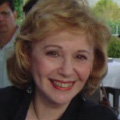
Ruth Prigozy
Professor Ruth Prigozy in 1978
Dr. Prigozy can trace her affinity to the author back to her own college years. She attended Brooklyn College and did her graduate work at CUNY. "In college I took a course in American literature," she said. "Fitzgerald was not well known in those days, and there happened to be a short story ["Winter Dreams"] in one of the books that really fascinated me. When I was doing my Ph.D., there really hadn't been any major research on Fitzgerald and his short stories." As part of her doctoral research, Dr. Prigozy commuted regularly to Princeton University where Fitzgerald's papers were housed.

When asked why she is so drawn to Fitzgerald, she doesn't hesitate: "The language. His work is so beautifully written. There are passages that make you stop, and you feel you have to read them over again. And then there are the subjects – the contrast between wealth and poverty and also his appreciation of the struggles of young people."

Dr. Prigozy first taught as an adjunct at Lehman College before coming to Hofstra. "In those days I felt – as did many – that in order to get tenure you had to be published. The first work I published was on the relationship between Fitzgerald and Ernest Hemingway – a subject I found fascinating. I sent it off, not to a scholarly publication but to a popular magazine called Commonweal. They took it immediately, and it's still quoted today. That was the first time anyone had written about the relationship between the two writers. I think that's what set me off, and I became known as a Fitzgerald scholar."

There were two notable relationships formed at Hofstra that are very close to Dr. Prigozy's heart. The most important was meeting and marrying fellow professor and Mark Twain scholar Stanley Brodwin, who passed away in 1995. The second was her founding of the F. Scott Fitzgerald Society in 1992 with Jackson Bryer of the University of Maryland and Alan Margolies of CUNY. "The three of us were talking at an American Literature Association conference. There had been a lot of societies formed to recognize writers. It had been going on for 10 years or so. There was a Hemingway Society, a Mark Twain Society, but nothing for Fitzgerald. So the three of us decided we should start a Fitzgerald Society. I remember I ran into Jim Shuart, Hofstra's president at the time, and Dick Block, who was vice president, and asked them if Hofstra could start the Fitzgerald Society. They said, 'Sure, go ahead!' And that's just how it started."

Every other year since its inception, the Fitzgerald Society has hosted major conferences, alternating locations between the U.S. and abroad. "The last one was in Lyon, France, and we've done them in Paris, London, Switzerland, St. Paul [Fitzgerald's birthplace]. The next one will be in Montgomery, Alabama – where Zelda Fitzgerald lived."

The Great Gatsby has been back in the news recently because of a new 3-D film starring Leonardo DiCaprio, scheduled for release late in 2012. Though Dr. Prigozy has been called by the filmmakers with questions about the novel, she can't help but be skeptical about the movie's chances for success. "I've come to the conclusion and would agree with a lot of other scholars that it's a book that really can't be easily made into a film. The essence of the book is the writing. They are probably focusing on the parties and exteriors. If you can't get into the characters, you are going to have a hard time making a good adaptation of the novel."

However, Dr. Prigozy is not surprised that the novel continues to find new admirers. Given America's current troubled economy, Gatsby's themes are more relevant than ever. "One of the most powerful elements of the book is that it's so reflective of our society – the American dream, the struggle for success. The whole idea of looking for success and feeling that, as Americans, it's out there for us. Now when we've been going through a recession, I have seen more questions and references to Gatsby than I have ever seen before.

"Gatsby is set at a time, 1925, in the Jazz Age. Fitzgerald enjoyed immense popularity, and then he became a victim of the Great Depression. He was living at the top of the world and then there was the failure, 'The Crack-Up,' as he describes it, in the 1930s. It is very interesting to me how so much of our history is reflected in The Great Gatsby and in Fitzgerald's own story. Their popularity recurs as we [Americans] have more problems and economic struggles."


(L to r) Actress Tippi Hedren, Dr. Prigozy, and biographer and film historian Donald Spoto at the 1999 Hofstra symposium on Alfred Hitchcock.
Dr. Prigozy's research on Fitzgerald has also prompted her to consider writing a book that will reexamine his tempestuous relationship with Zelda Fitzgerald. "Her influence on Fitzgerald was not positive as represented in the books written on her during the 1970s through the 1990s. He supported her throughout her life, and she made his life extremely difficult always."

Perhaps it's not surprising that Dr. Prigozy is drawn to other cultural icons whose successful careers have been marred by tragedy. In 2006 she published The Life of Dick Haymes: No More Little White Lies. At one time, Haymes, a singer and actor, had been as popular as Frank Sinatra and Perry Como, but he lost the support of his fans because of drinking, financial problems, multiple failed marriages and Hollywood gossip. Dr. Prigozy says, "I feel that if you listen to Dick Haymes today, he was just one of the most wonderful singers. But his life was a tragedy – he had one of the best voices and at one time was more popular than Sinatra. It's a tragic American story – kind of Gatsby-esque."

For the last few years, Dr. Prigozy has been working on a book about another singer/ actor who experienced a similar surge in popularity and then downfall – Gordon MacRae, best known for starring in the movie musicals Oklahoma! and Carousel. "I loved his voice," she says. "He starred in these movies and then he became a forgotten man. His drinking really affected his career. I feel he, too, is a kind of neglected figure."

Fitzgerald once wrote, "Show me a hero and I'll write you a tragedy." Dr. Prigozy is considering writing biographies on Frank Sinatra and Hugh Jackman, but she has found the rewards are greater in bringing attention to cultural icons who were cast aside, like Haymes and MacRae, as she did for Fitzgerald. "I have the feeling it's nice to do something for somebody people don't appreciate."

Dr. Ruth Prigozy and the Hofstra Cultural Center

"Working with Ruth Prigozy is an education in literary history," says Natalie Datlof, executive director of the Hofstra Cultural Center. "Her knowledge is endless, her enthusiasm boundless and her spirit of inclusion allows you entrance into the magical world of the authors, playwrights, and filmmakers under study."

No other Hofstra faculty member has directed or co-directed as many conferences and symposia as Ruth Prigozy. "I just love working on the conferences," Dr. Prigozy says. "I think Hofstra has an amazing reputation for presenting them, and they are a tremendous contribution to not just local culture, but our country's culture."

Being a key figure in the development of these conferences is no easy task. Some of these events take years to pull together. They involve inviting key figures on the specific subjects, scheduling panel discussions, special lectures, dinners, and musical or theatrical presentations.

"I like working on them," says Dr. Prigozy, "because they broaden my understanding of the subject and of the cultural arena. They have allowed me to meet other people in the academic world, and that has really been fascinating."

Of the seven major events she's worked on, Dr. Prigozy says the 1992 F. Scott Fitzgerald Conference is the one she remembers most fondly. "Of the people we were able to get, many have since passed on, like Budd Schulberg and Ring Lardner, Jr., whose father was Fitzgerald's best friend. Fitzgerald's granddaughters and people he knew from St. Paul were also there."

Hofstra Cultural Center Conferences and Symposis Directed by Dr. Prigozy
  • Detective Fiction and Film in Honor of the 100th Anniversary of the Birth of Agatha Christie (1991)
  • Eighth International F. Scott Fitzgerald Conference (1992)
  • Alfred Hitchcock: In Celebration of the 100th Anniversary of the Birth of Alfred Hitchcock (1999)
  • A Robert Anderson Retrospective: Theater and Film (2000)
  • John Steinbeck's Americas (2002)
  • Bing! Crosby and American Culture (2002)
  • F. Scott Fitzgerald on Long Island and New York (2005)

Twitter Delicious Facebook Digg Stumbleupon Favorites More